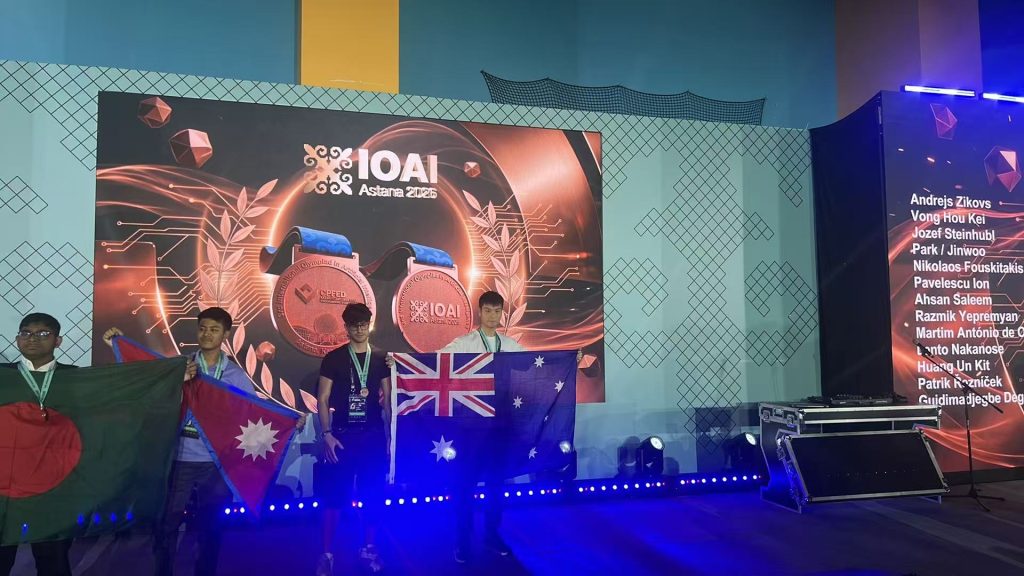
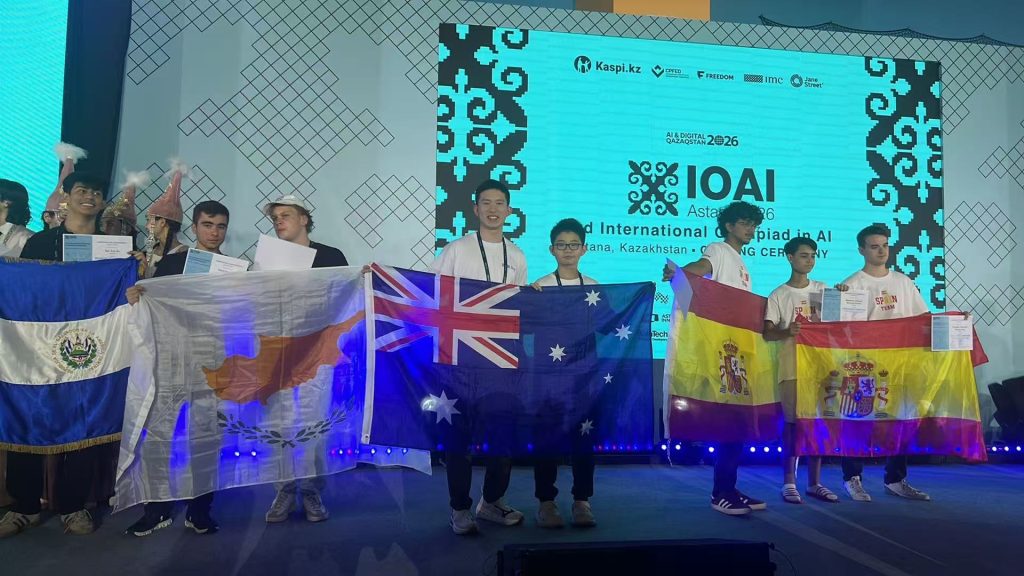
One Bronze Medal and Two Honourable Mentions for Team Australia
Australia IOAI 2026: A Major Step Forward in Kazakhstan.
Australia recorded a significant improvement at the 3rd International Olympiad in Artificial Intelligence (IOAI), held in Astana, Kazakhstan, from 2–8 August 2026.
Competing against students from around the world, the Australian delegation achieved:
🥉 Bronze Medal
Andy Yue He – Australia 1
🏅 Honourable Mention
Chunting Li – Australia 2
🏅 Honourable Mention
Vincent Yingxi Chen – Australia 1
The result represents an important step forward for Australia’s IOAI program, with three Australian students receiving individual recognition in 2026.
Clear Progress from 2025 to 2026
Australia’s performance in Kazakhstan demonstrated substantial year-on-year progress. At IOAI 2025 in Beijing, Australia achieved an important breakthrough with a Bronze Medal in the Theory Round, building on the country’s Practice Round Gold Medal from its 2024 debut.
In 2026, the Australian delegation expanded on that foundation by achieving one individual Bronze Medal and two Honourable Mentions, demonstrating greater depth across the team and stronger overall competitiveness. This improvement reflects the continued development of Australia’s national AI Olympiad selection and training system. Rather than focusing only on a small number of highly experienced students, the Australian program has continued to broaden access, strengthen the national talent pipeline, and provide students from different schools and states with opportunities to develop advanced AI skills.
IOAI 2026 – Astana, Kazakhstan
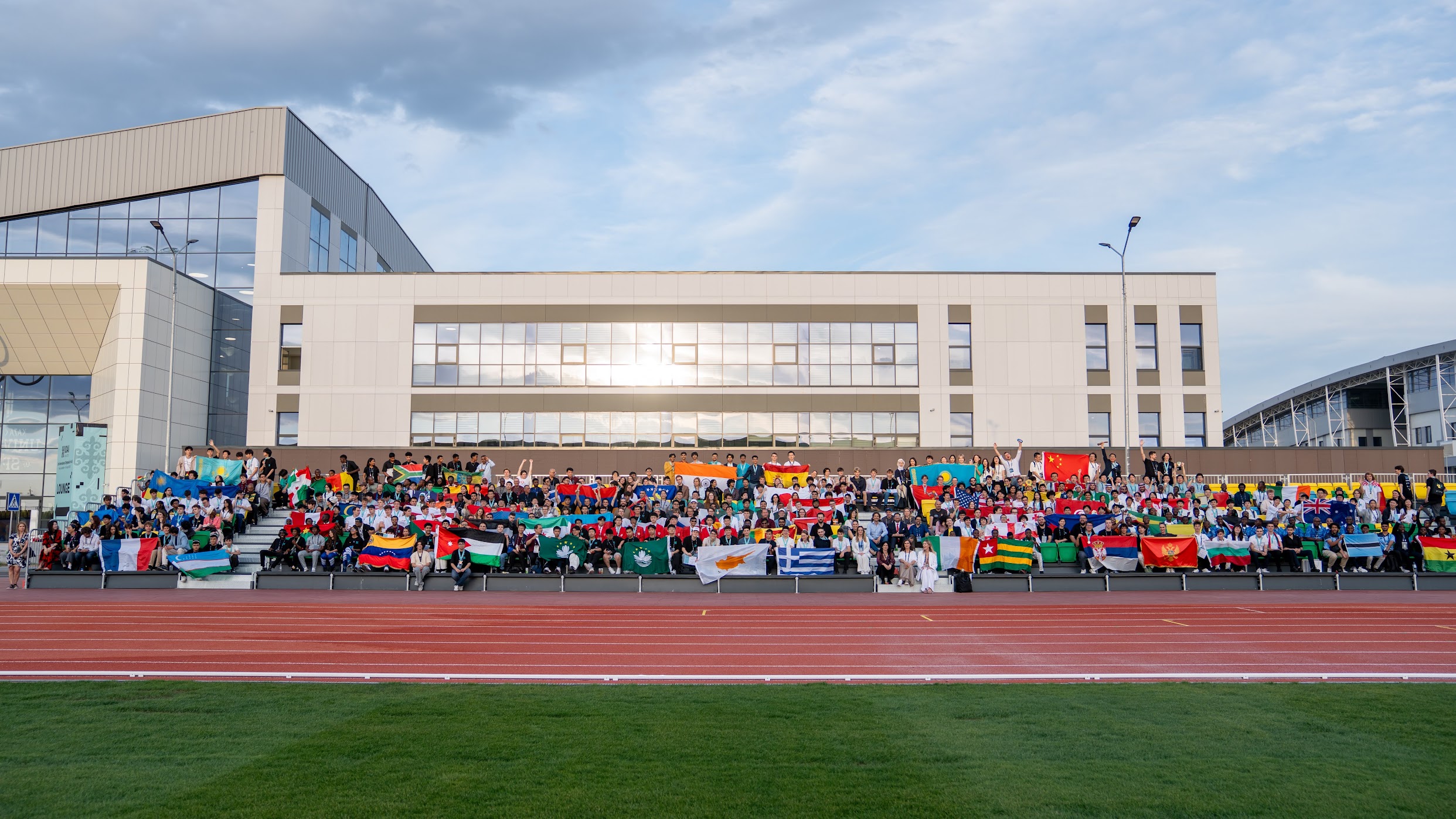
The third edition of IOAI was hosted in Astana, the capital of Kazakhstan, from 2 to 8 August 2026.
The competition brought together some of the world’s strongest secondary-school students in artificial intelligence.
The 2026 individual competition challenged participants across a broad range of AI topics and problem-solving environments. Students were required to demonstrate not only technical knowledge, but also adaptability, independent learning, programming ability, and the capacity to work with unfamiliar AI systems under strict competition conditions.
The competition included two major individual competition rounds as well as team and educational activities throughout the week.
Building a Stronger National AI Pathway
Australia’s 2026 preparation represented a major expansion of the national IOAI pathway.
Students participated in a structured national selection process involving online rounds, advanced selection activities, national training, and final selection.
The Australian program has increasingly focused on building a sustainable pathway rather than preparing students only immediately before the international competition.
This includes:
nationwide school outreach;
online selection rounds accessible across Australia;
in-person national training;
structured AI theory and programming preparation;
participation in regional and international AI competitions;
school-based AI clubs and training opportunities;
scholarships and financial support designed to reduce barriers to participation.
The long-term objective is to make advanced AI education accessible to a broader range of Australian secondary-school students while maintaining a rigorous and transparent national selection process.
From Participation to Competitive Depth
Australia’s IOAI journey has developed rapidly over three editions.
2024 – Bulgaria
Australia made its IOAI debut and achieved a Gold Award in the Practice Round, demonstrating strong practical and creative AI capability.
2025 – Beijing
Australia achieved a Bronze Medal in the Theory Round, representing a major improvement in theoretical AI performance.
2026 – Kazakhstan
Australia achieved one Bronze Medal and two Honourable Mentions in the Individual Contest, showing greater depth across the national team.
The progression from a single area of strength toward multiple internationally recognised individual performances reflects the increasing maturity of Australia’s AI Olympiad program.
Developing Australia’s Next Generation of AI Talent
The purpose of the Australian IOAI program extends beyond medals.
AI is becoming a foundational technology across science, engineering, medicine, cybersecurity, robotics, finance, and many other fields. Australia needs young people who understand not only how to use AI systems, but how they work, how they can be improved, and how they can be applied responsibly.
Through IOAI, Australian students gain opportunities to:
study advanced artificial intelligence while still at school;
solve challenging real-world and research-inspired problems;
meet talented students from around the world;
develop resilience and independent problem-solving skills;
build international academic and professional networks;
explore future pathways in AI, computer science, engineering, and research.
The achievements in Kazakhstan demonstrate what Australian students can accomplish when they are given access to structured training and international opportunities.
Looking Ahead to IOAI 2027
The 2026 results are an encouraging milestone, but they also highlight the opportunities ahead.
Australia will continue to strengthen its national selection and training system, expand school participation, and provide more students with access to high-quality AI education.
Following the clear improvement from Beijing 2025 to Kazakhstan 2026, the next objective is to further increase the depth and consistency of Australia’s international performance while continuing to build a sustainable national AI education ecosystem.
Australia’s progress at IOAI is not simply about producing medal winners.
It is about developing a generation of young Australians who can participate confidently in the global AI community and contribute to the future of artificial intelligence.
Congratulations to all members of Team Australia and to every student, parent, school, coach, volunteer, partner, and supporter who contributed to the 2026 journey.